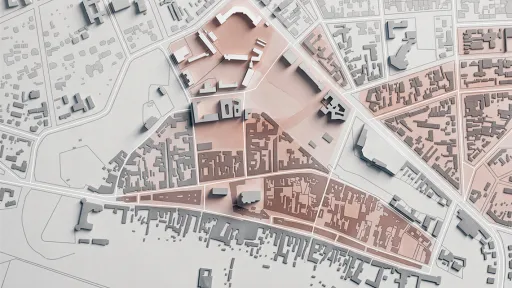
As a Decision Making Process
The development of a place extends beyond a single site. Uses, routes, open spaces and existing structures need to work together. We reveal a site's possibilities and develop a clear direction that can support informed decisions.
Developing historic places for contemporary urban life
Carry history forward
Historic spaces, materials and traces of earlier use give a place its character. We examine these qualities and develop a distinctive architecture for contemporary uses. The history of the existing fabric remains legible.
Shape spaces with precision
Light, proportions, materials and acoustics shape how people experience a space. We consider these qualities alongside the transitions between street, square and courtyard. Sequences of rooms and places to spend time grow from the existing fabric and its conservation requirements.
Plan use and operation together
Working, learning, making and meeting need suitable spaces and reliable operation. We establish which needs are evidenced, which uses work together and how access, management and day-to-day operation can be supported. This provides a use concept that can be evaluated.
Ground decisions in research
Local knowledge and spatial analysis help assess entrances, connections, detours and uses, and compare alternatives. Depending on the commission, we support statutory planning under the German Building Code (BauGB) and coordination with authorities and stakeholders. Once a project has been implemented, its effects can be assessed through actual use and accessibility.

Urban development in design
Forum Alte Canzley
Lutherstadt Wittenberg · Design and use concept
The design completes the block edge at Schlossplatz and explores a mix of housing, cultural and commercial uses.
Design and use concept: Marco Gernt Architekten. The images show a proposal for further development, not an approved building programme.
The Lutherstadt Wittenberg study shows how we read a place and make spatial change understandable.
Related services

